


An efficient financial consolidation process is not about how fast a finance team can complete it, but about how much control they have, how well they define relevant perimeters and group policies, as well as how accurate their intercompany eliminations are.
With the right foundations in place, a faster, more efficient close certainly follows.
This guide sets out what good consolidation practice looks like for multi-entity financial services businesses, including what consolidation really involves, how the process works step by step, and how technology such as Infor EPM makes good practice repeatable. Alongside it, a complimentary self-assessment and checklist help you see exactly where your own process stands today.
What financial consolidation is not
Most guides would start by defining consolidation. We would rather start by clearing away four common misconceptions, because they explain why so many groups still find the process slow and stressful.
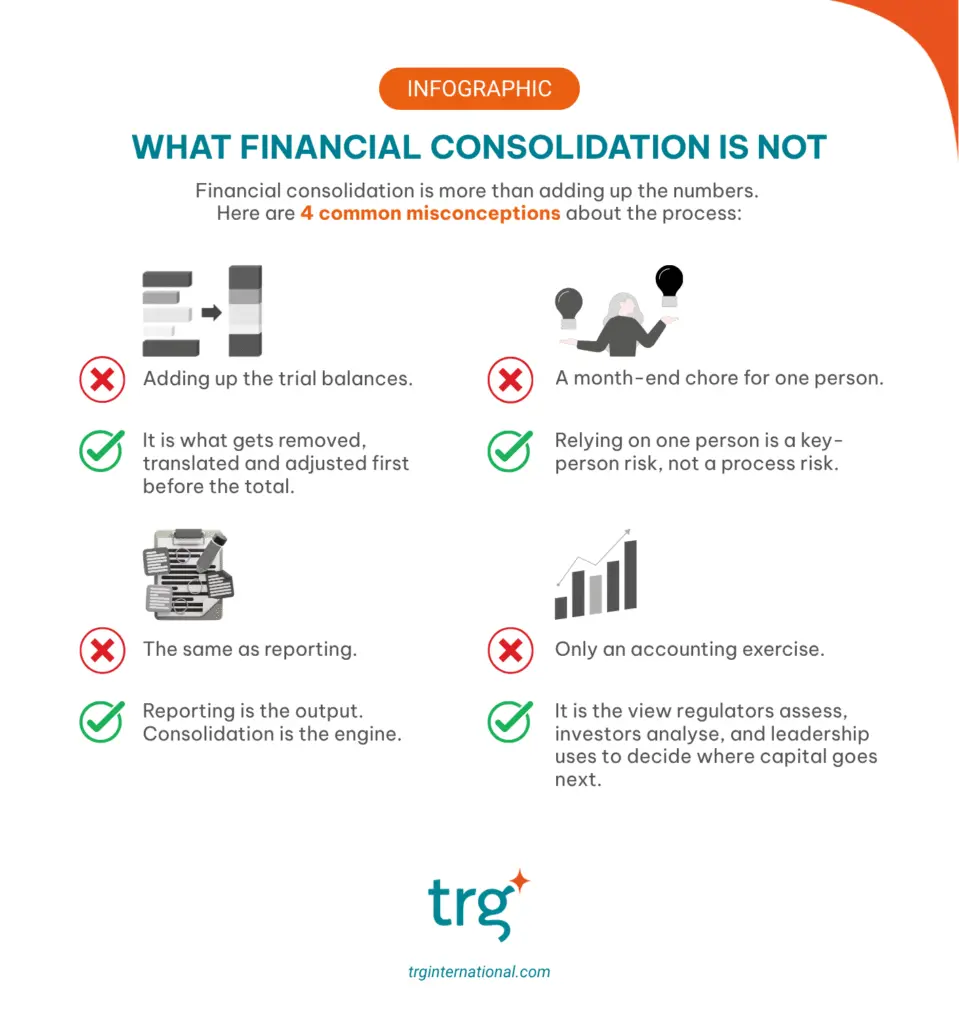
It is not adding up the trial balances
If consolidation simply meant summing each entity’s numbers, any spreadsheet could do it.
In reality, the hard work is what must be removed, translated, and adjusted before the total means anything. For instance:
- Intercompany loans between the bank and its subsidiaries
- Management fees charged across the group, currency movements
- And ownership structures where the parent does not hold 100 per cent
A group total that skips these steps is not a smaller version of the right answer. It is the wrong answer.
It is not a month-end chore for one person
In many organisations, consolidation has quietly become the responsibility of one experienced accountant who “knows how the file works”. That is a key-person risk dressed up as a process. When that person is on leave, or leaves for good, the group discovers how much of its reporting depended on undocumented judgement.
Read more: Your Spreadsheet Is Not the Problem. Your Spreadsheet Dependency Is.
It is not the same as reporting
Reporting is the output that the board, regulators and investors see. Consolidation is the engine underneath it, the rules, mappings, eliminations and controls that make the output trustworthy. Organisations that invest in better-looking dashboards without fixing the engine usually end up presenting inaccurate numbers more attractively.
It is not only an accounting exercise
For financial services groups in particular, the consolidated view is what regulators assess, what rating agencies and investors analyse, and what leadership uses to decide where capital goes next. When it arrives late or needs restating, the consequences reach far beyond the finance department.
So what is financial consolidation, and what does good practice look like for a bank, insurer or investment group operating across several entities and countries? That is what the rest of this guide sets out to answer today.

What is financial consolidation?
Financial consolidation is the process of combining the financial results of a parent company and the entities it controls into one set of group financial statements, presented as if the group were a single economic entity. Under IFRS 10, the international standard that governs it, a parent that controls one or more subsidiaries must present consolidated financial statements covering the group’s assets, liabilities, equity, income, expenses and cash flows [1].
The phrase that matters most in that definition is control. IFRS 10 uses control as the sole basis for deciding which entities to consolidate, and it expects the parent to apply uniform accounting policies across the group [2]. Having said that, the situation is different in financial services than, let’s say, a manufacturing group.
Consider a few situations that are routine for banks, insurers and asset managers:
- An asset manager runs funds on behalf of clients. Does it control those funds, or is it acting as an agent? IFRS 10 is clear that an investor exercising decision-making rights delegated to it as an agent does not control the investee [2], but reaching that conclusion takes judgement and documentation.
- A group qualifies as an investment entity. The standard then requires it to measure certain subsidiaries at fair value through profit or loss rather than consolidating them line by line [1].
- A bank holds 40 per cent of a consumer finance company, with the remaining shares widely dispersed. Whether that stake amounts to control depends on the facts, not on the percentage alone.
This is why good consolidation practice in financial services begins before a single number is collected. The perimeter, i.e., the list of entities in scope and how each one is treated, needs to be agreed, documented and reviewed whenever ownership or structure changes. Everything that follows depends on it.
In short: consolidation turns many legal entities into one economic picture. The accounting is mechanical once the perimeter is right. Getting the perimeter right is not.
Read more: Future of Financial Consolidation: Faster, Clearer, Connected
Why do financial services groups need financial consolidation?
At first glance, consolidation looks like a compliance obligation. Look a little closer, however, and it becomes clear that the same process serves several audiences at once, each asking a different question of the same numbers. Broadly, the reasons fall into three groups.
Building one reliable picture of the group
The starting point is combining entity-level financial information. A banking group might hold a commercial bank, a securities firm, a leasing company and a fintech subsidiary, each with its own ledger, close calendar and, quite often, its own system. Until those results are brought together, nobody can confidently say how the group as a whole is performing.
Combining is not enough on its own, though. The group also needs to prepare group-level financial statements that present the parent and its subsidiaries as a single economic entity, as IFRS 10 requires. That, in turn, depends on standardising information by mapping each entity’s chart of accounts to a common group structure and applying uniform accounting policies. Without that discipline, the group is comparing figures that look alike but mean different things.
Read more: What does Unified Ledger Accounting Mean to Accountants?
Then there is the step that most clearly separates consolidation from simple aggregation: eliminating intercompany transactions. When the bank lends to its leasing arm, or the parent charges each subsidiary a management fee, those balances are real at entity level but meaningless at group level. Left in, they inflate revenue, expenses, assets and liabilities, and in financial services, where intra-group funding is common, the distortion can be large.
Meeting outside expectations
For financial services, regulatory reporting is often the most demanding audience. The Basel Framework, for example, is designed to apply to internationally active banks on a fully consolidated basis, so that supervisors see the risks of the banking group as a whole [3]. This means the regulatory perimeter does not always match the accounting perimeter, and finance teams may need to produce more than one consolidated view from the same data.
Investor reporting adds another layer. Shareholders, bondholders and rating agencies judge the group on its consolidated results, and they notice when numbers arrive late, change after publication or cannot be explained clearly. For a listed bank or insurer, consolidation quality is ultimately a question of credibility.
Learn more: Can Your Bank Reconciliation Process Be More Efficient?
Running the business better
Management visibility depends on a consolidated view that is available soon enough to act on. A group P&L that appears six weeks after quarter-end tells leadership what happened, not what to do next.
Cross-entity performance analysis is where consolidation starts to pay for itself. Once every entity reports on the same basis, leaders can compare return on capital between the bank and the insurer, see which country is absorbing the most group funding, or test whether a subsidiary is genuinely profitable once its share of central costs is included. These are strategic questions, and they can only be answered from consolidated, comparable data.
Read more: What’s Better? Financial Consolidation Software or Spreadsheets?
How does the financial consolidation process work?
The consolidation process moves data from entity ledgers to group reports in eight broad steps, each relying on the one before it.
- Collect entity data. Each entity submits its trial balance and the supporting detail the group needs, such as intercompany balances, ownership changes and, in financial services, data for regulatory schedules. Best practice is to agree on a fixed submission calendar and a single template so data arrives on time and in the same format every period.
- Validate financial information. Before combining anything, check the data. Does the trial balance balance? Are mandatory fields complete? Do key ratios look reasonable compared with last period? Catching a problem here takes minutes. Catching it after the board pack has gone out can take a restatement.
- Standardise data. Local charts of accounts are mapped to the group chart, and local accounting policies are aligned with group policies.
- Translate currencies. Entities reporting in VND, THB, SGD or other currencies are translated into the group reporting currency, typically using closing rates for the balance sheet and average rates for the income statement, with the difference recorded in a translation reserve. The rates and method should be set centrally, not chosen entity by entity.
- Identify intercompany transactions. Loans, deposits, interest, fees, dividends and shared-service charges between group entities are flagged and matched. Mismatches, often caused by timing or currency differences, are investigated and resolved before the elimination step, ideally during the month rather than at the end.
- Process eliminations. Matched intercompany balances are removed so the group does not report income it earned from itself.
- Consolidate balances. The adjusted, translated and eliminated figures are combined, non-controlling interests are calculated, and top-side adjustments are posted with documented reasons and approvals.
- Produce group reports. The consolidated results feed the statutory financial statements, management reports, board packs and, for regulated entities, the supervisory returns. As these audiences need different views, the reporting layer should draw on one consolidated dataset rather than separate copies.
Written down like this, the process looks orderly. In practice, steps one to six are where most groups lose their time, and where most errors are introduced.
TRG has already covered the main challenges in financial consolidation in various resources. For a more detailed and up-close analysis of them, check out the links below:
It’s time to move on from legacy tools for an improved financial consolidation process
None of the challenges above is new, and most finance teams have spent years working around them with better templates, longer checklists, and, most certainly, more late nights. At some point, though, the workarounds become the problem.
Dedicated consolidation solutions go beyond making the process faster. It changes where the rules live, moving them out of people’s heads and spreadsheets and into a controlled system.
Six capabilities make the biggest difference.
Automated data collection
Instead of emailing templates and waiting for replies, entity data is loaded directly from source ledgers or submitted through a standard interface with built-in checks. Late or incomplete submissions become visible immediately, and finance spends the first days of the close reviewing numbers rather than collecting them.
Centralised consolidation
When every entity, mapping rule and adjustment sits in one environment, a change is made once and reflected everywhere. That removes the need to keep parallel versions in step and gives the group a single source of truth for statutory, management, and regulatory views.
Automated elimination processing
Intercompany rules are configured once, then applied every period. Matching, eliminations and the allocation of unrealised profit between the parent and non-controlling interests run as part of the process rather than as a separate manual exercise. Differences are flagged early, while there is still time to resolve them.
Multi-currency handling
Exchange rates are maintained centrally, and translation is applied automatically according to the group’s method, including the calculation of translation differences. For groups operating across Vietnam, Thailand, Singapore and beyond, this removes one of the most common sources of silent error.
Audit trails
Every data load, mapping, adjustment, and approval is recorded, including who made it and when. Rather than reconstructing the story behind a number at audit time, finance can trace any consolidated figure back to its source. For regulated financial services firms, this traceability is increasingly an expectation, not a bonus.
Faster reporting
With collection, validation, translation and eliminations automated, the consolidated dataset is ready sooner, and reports can be generated from it on demand. As a result, finance gains back time to analyse the results rather than assemble them.
Ask yourself: If your consolidation lead resigned tomorrow, how much of your process would leave with them?
Read more: Future of Financial Consolidation: Faster, Clearer, Connected

Case in point: How businesses worldwide consolidate their finances
Best practice is easier to judge when you can see it working, or failing, in a real organisation. The two cases below sit at opposite ends of the scale, yet they share a lesson named “quality data”.
Citigroup: When data quality becomes a regulatory issue
In July 2024, US regulators fined Citigroup US$136 million for making insufficient progress on data management problems first identified in 2020, when the bank had already been fined US$400 million over deficiencies in risk management, internal controls and data quality management. According to Reuters, the Federal Reserve found the bank had missed milestones in its remediation plan, and the OCC required a new quarterly process to show it was devoting enough resources to the work [4].
Citi is a global bank, and its case is about enterprise data governance rather than consolidation alone. Still, the lesson travels well. Regulators increasingly expect financial institutions to show how they produce, control, and trace the numbers they report back to source. A consolidation process that relies on spreadsheets and undocumented adjustments makes that very hard to demonstrate, whatever the size of the group.
Learn more: The Secret to Successful Automation – It Starts with Clean Data
Astra Life: Two parents, one regulator and a tighter close
PT Astra Aviva Life, a 50:50 joint venture between Indonesia’s Astra International and the UK insurer Aviva, faced a demanding reporting structure from the start. It had to report to both parent groups and Indonesia’s Financial Services Authority (OJK), at a time when tighter regulation meant late submissions could lead to penalties and, at worst, put its licence at risk.
After moving its finance operations to Infor SunSystems and building reusable reporting templates for the regulator, Astra Life cut its financial reporting cycle by 6 days and reduced reporting time to OJK by 75 per cent.
Around 70 per cent of its regulatory reporting was generated automatically, and it kept its finance headcount constant while total company headcount grew from 200 to 500. The company then added Infor EPM to connect its ledger with its claims and actuarial systems and give management a consolidated view of revenue, claims, commissions and expenses.
Is technology really better than spreadsheet software like Excel? Don’t rush into making decisions yet; check out our following resources first:
- Financial Consolidation Solutions vs Spreadsheets: Which One is Better for Your Business?
- The Use of Spreadsheets and Modern Cloud Adoption in Businesses
Know your gaps before you talk to vendors! Pinpoint your weakest areas in the consolidation process and turn them into an action plan you can take into any software conversation. Simply fill out the form on the right-hand side to download our complete checklist and self-assessment →
Let Infor EPM enhance your financial consolidation processes
TRG International believes technology should follow the process, not the other way round. The groups that get the most from a new consolidation platform are those that first establish their perimeter, policies, and close calendar, then use the system to enforce them.
Once the foundations are set, Infor EPM is designed to take over the most time-consuming, highest-risk steps. Its Financial Consolidation module creates consolidated group financial statements. It also supports IFRS- or GAAP-compliant processes by tracking data from source systems through financial reporting in a controlled, auditable way, while automatically processing elimination entries and currency conversions to produce audit-ready statements.
Here is how those capabilities line up with the areas in this guide:
| Best-practice area | How Infor EPM supports it |
|---|---|
| Data collection and validation | Integrates with Infor Data Lake and third-party ledgers, including Infor SunSystems, and validates incoming data through trial balance checks |
| Standardisation | Each entity can keep its own chart of accounts, local currency and reporting standard, mapped into the group structure |
| Currency | Exchange rate conversion is automated at entity level |
| Intercompany and eliminations | Intercompany matching and elimination are handled automatically, with group structures that reflect different ownership percentages |
| Control and audit trail | Data is traced from source to report in a controlled, auditable way |
| Close management | A Status Monitor gives a group-wide view of consolidation progress, showing which entities have not yet submitted |
| Reporting | Browser-based dashboards, self-service reporting and native Excel integration |
Technology alone does not make a consolidation process best practice. What it does is make good practice repeatable by applying the same rules every period, the same audit trail for every adjustment, and moving away from one person’s spreadsheet.
Have you checked out our financial consolidation self-assessment? Where did your result land? Talk to a TRG consultant about your results and see how Infor EPM could close the gaps in your consolidation process.


References
1. https://www.ifrs.org/issued-standards/list-of-standards/ifrs-10-consolidated-financial-statements/
2. https://www.icaew.com/technical/financial-reporting/ifrs/ifrs-standards/ifrs-10-consolidated-financial-statements
3. https://www.bis.org/fsi/fsisummaries/scope_app.htm
4. https://www.businesstimes.com.sg/companies-markets/banking-finance/citigroup-fined-us135-6-million-over-internal-control-problems